
Water.

I was trying to come up with a snappy title above, but to get the point across about what I want to talk about it seemed all I needed was one word. Revisiting our four required elements for plant growth, having enough water (along with light, temperature, and nutrients) allows us to grow plants, and in our case grass plants. For those that have been at Olympic View for sometime you are well aware that we have always been challenged with having enough water. You can revisit this post from last summer where I talked about how we significantly increased out irrigation water budget for 2024. Here is a quick line from that post:
“Regardless of the level or quality of equipment, specialty products, labour, or technical competency we put towards fairways, our water supply was capping us at 70% quality of what our fairways could be.”
Due to some timely rainfall & judicious watering practices throughout last summer we didn’t actually need to purchase any water at all. Having the water in the budget allowed us to water appropriately through a warm July 2024, and we had saved enough water in May & June to cover August & September. Win win.
Now fast forward to July 2025:
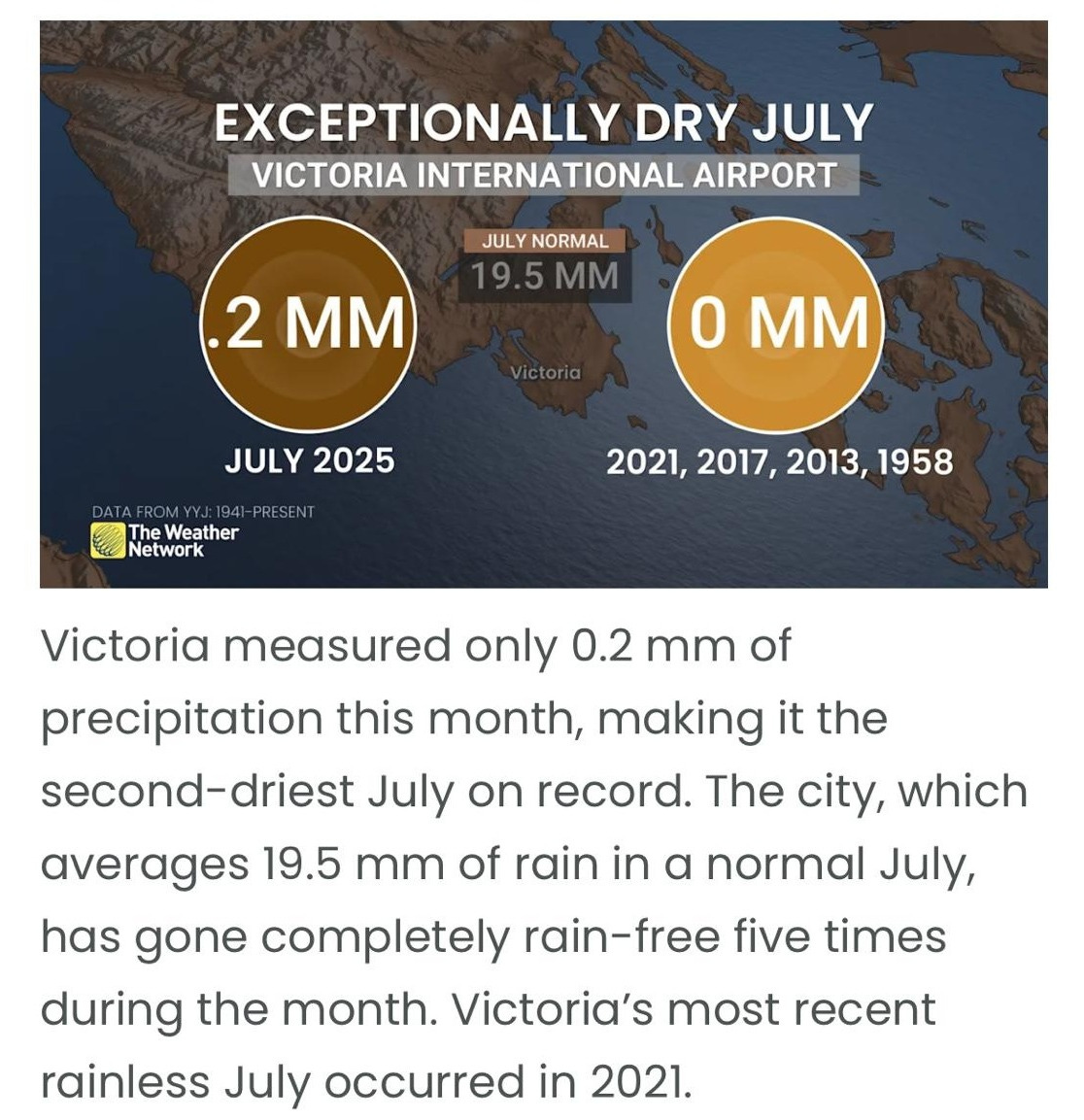
I’m sure everyone remembers the heat dome year of 2021. I know I still have nightmares about it that’s for sure. First year as a Superintendent and it’s 42 degrees! Anyways, back to the point here. Even though it has been a warm & dry last couple months, we have been able to keep the course reasonably green. While I’m not striving for a colour, the green shade is in indicator of a healthy, actively growing plant, that will provide a quality surface for which to land and strike a ball off of. Now across 10 hectares of fairways are we perfectly uniform and green? Na, of course not. While maybe that is a goal, it’s neither a realistic goal nor a sustainable level.
So what goes into managing the amount of water that goes out on the course each day? Let’s touch on a few of the key steps we carry out.
Weather
Well of course this is step one. Not only do we use on site temperature and rain sensors, we also download daily computer generated models of weather specifically for Olympic View. This data generates the amount of water lost in a day, or the daily “ET”. This stands for evapotranspiration and represents the evaporation of water from the ground and the transpiration of water through the plant as it performs its daily growth and self cooling practices. I can tell you that for the last week the daily average ET has been 3.6 mm. Putting on my math hat, 3.6 mm of depth spread across 1 square meter, to a 10 cm depth (roughly our growing depth) represents 3.6 litres of water. Isn’t the metric system vastly superior to any other form of measurement?!?!?! Ok, so now we have a theoretical idea of how much water has been consumed and therefore how much we need to re-apply each day.
Computer Control
Ever so slightly before I started in the industry 30 years ago, golf courses have been able to use specific computer software to control irrigation systems. While I still feel their capabilities are sorely lagging, there are some exciting new technologies on the horizon. That’s for another article though. For now, at Olympic View, we were fortunate to upgrade our central control system to the latest and greatest in 2023. We can enter in our pipe sizes, spacing of sprinklers, nozzle sizes, and water pressure in, and then tell the system that we want to put 3.6 mm of water on the 10th green tonight. Not only will it calculate the right time for the sprinklers surrounding the 10th green to run (say it’s 10 minutes) it will also calculate all the other times for all the other sprinklers across the course to run. They obviously can not all run at once, so it times the whole night out using the limitations of the amount of water we can supply to each area of the course at one time (pipe size & pressure). While this sounds complex (and it is) this is pretty much what these systems have been able to do for 30 plus years now, only each new version has cooler graphics. Anyways, so we have the amount of water we need to apply and then told the computer to apply it, job done right? Naaaaa.
Efficiency
The best designed, brand new irrigation system is maybe 80% efficient. Pesky things like wind, slopes, designing around curved shapes like greens all contribute to non-uniform water distribution across large sites like golf courses. Now take our system at Olympic View that was deigned “economically” with the latest and greatest knowledge 1988 had to offer and we are sitting around 60% efficiency at best. That’s even a stretch. So what does that mean? Well that means that some spots within the 10th green will get 40% less than 3.6 mm and some will get 50% more than 3.6 mm. The chart below illustrates this challenge.
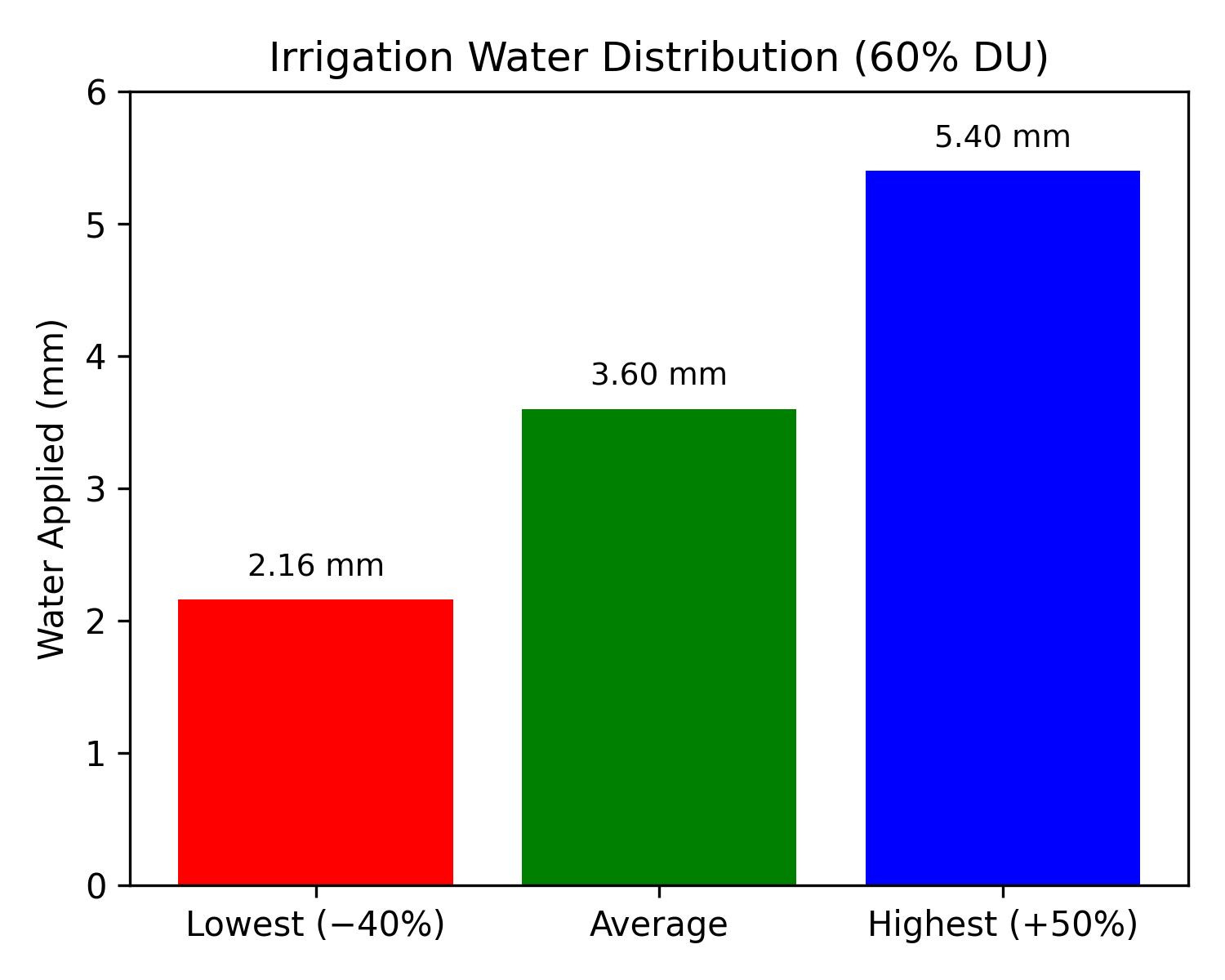
The worst part is these wet & dry spots are often no more than ten feet apart.
Chasing Uniformity
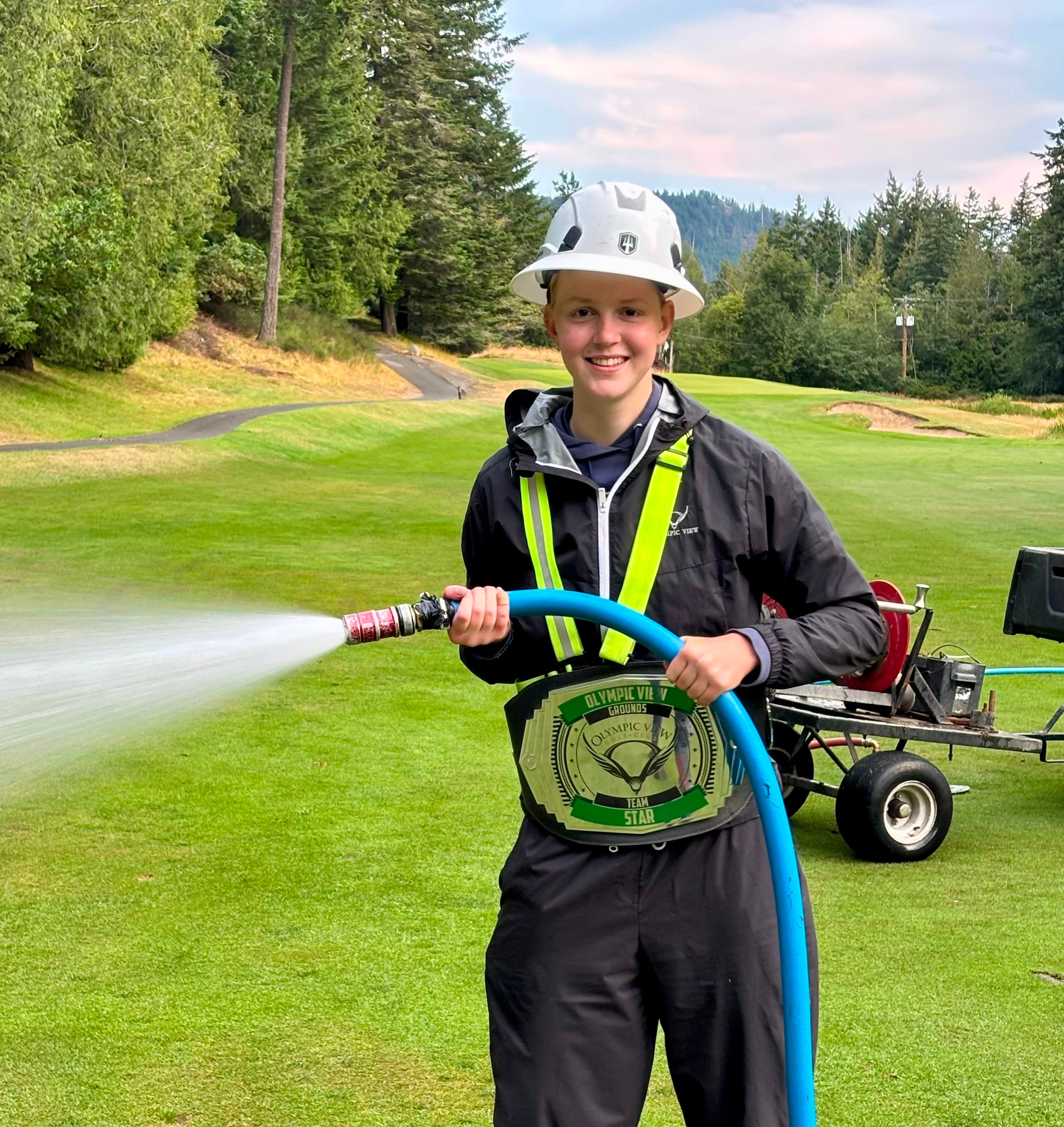
So if it’s not as simple as just setting and forgetting at the computer, how do we accurately get the water where we need it each day? The old fashioned way, with a hose. Each day we send out a minimum of two people and sometimes up to four with hoses. The idea being to put out just enough water with the sprinklers to not make things wet and then try and top up the low areas or dry spots with a hose. Seems like a simple plan when you are talking about the 10th green at a size of 500 square meters, but take that over the 25 hectares of turf we irrigate each night and it gets a little daunting.
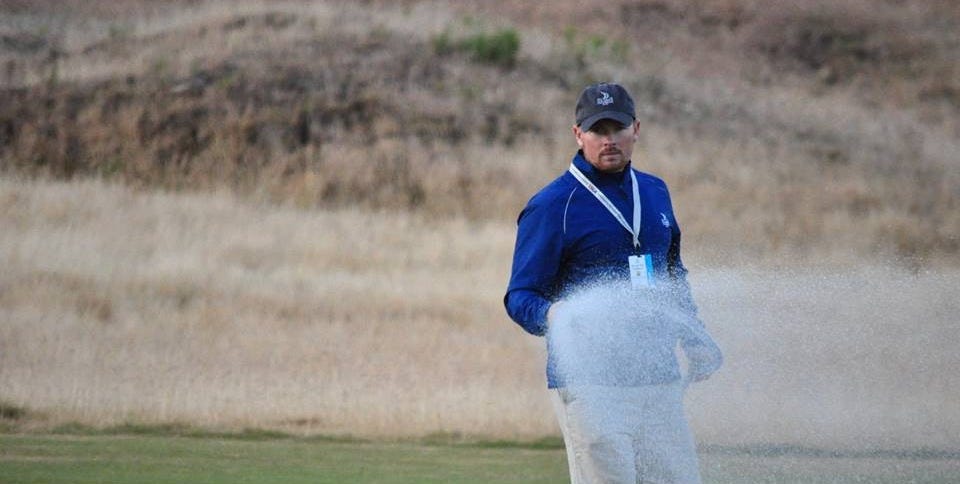
Thankfully we have a dedicated Team that dutifully caries out this task all summer. It may seem nice to be on a hose when it’s hot out, but often it’s not that warm at 6 am and an extended drought like we are in right now can be mentally taxing.
Ground Truthing
I mentioned before that the calculations of how much water is required is theoretical. We ground truth that data in a couple of ways. First we use our experience and expertise to not only evaluate the turf health but also signs of saturation or drought and yes, colour is a part of this. Secondly, we use a soil moisture meter to check the actual soil water content on each green.

We take 9-12 measurements on each green every day. The device gives us a percentage of soil moisture and we can now use that number to do some more cool math. 1% soil moisture equals 1 litre of water over 1 square meter, 10 centimetres deep. Which if you remember from before equals 1 mm of irrigation depth over that area.
So say we do not want the soil to get below 20% soil moisture by the end of the day. We also have a forecast that says that we are going to have an ET of 3.6 mm today. That person hand watering and taking moisture samples is going to make sure that each of the 9 quadrants on that green is above 23.6 (really 25%) so that we do not have any wilt on the green through the day. I was going to make a joke about how they measure out 3.6L of water and pour it evenly over each square meter of the green, but yeah, we’re not there yet….
When we set up the computer for the night, we will shoot for 70% or so of that 3.6 mm taking into account the challenges in system distribution uniformity. Don’t get the wet spots too wet and chase the dry spots with the hoses.
The Art
Numbers and hoses aside, there is an art to managing and irrigation system. Not only do you need to understand the microclimates around the course, you also need to know how hundreds of sprinklers heads throughout the course irrigate those areas. I have often said it takes 3 seasons to get to fluently managing a system. I started to learn, and am still learning the system at Olympic View 5 years in. Fortunately I have a great Team who know it even better than I do now. Assistant Superintendents Genghis Usher (5 years) and John Braddock (3 years) have been learning the art of managing our system over those respective times. They need to be constantly plugged into the system, the course, and the weather forecast in order to make the best daily decisions possible. That 70% of 3.6 mm I mentioned above could be 50 or 60% if the temperatures are dropping or if rain is coming, or it could be 90% if we are in a prolonged dry stretch and the wind has been blowing straight time for a few days. The combination of variables to consider and sprinklers to adjust are limitless.
I knew I was truly a Superintendent a couple years ago when I was told I was no longer allowed to touch the irrigation computer. Superintendents often have many many items on their plate making it impossible to stay in tune with all the details I mentioned above. If I was in charge of the system for a day or two, often I would make reactionary changes without knowing all the factors. Instead, I now leave it to the professionals and I think the product we are displaying right now is a fine example of their experience and expertise.
Wrap Up
Well if you stayed with me this long, you have now received a high level crash course in golf course irrigation. While I’m sure it was a bit extensive, hopefully it provides a bit more understanding of just one of the areas we cover each day. Long stretches like we are going through only exacerbate the challenges above and I truly appreciate the fantastic Team we have managing our watering.
Of course making those challenges slightly easier is having enough water to keep the course looking good. I’m thankful for the investment that the club has made into our irrigation water budget and I believe it is showing in the much improved condition of our fairways compared to a couple years ago. While we don’t have an unlimited supply, hopefully between what we have budgeted and some rainfall at some point, we will be able to hold on to the current course conditions.
There is a chance of rain in the forecast for next week and the great thing about rainfall it is the only way to get 100% distribution uniformity. Fingers crossed for just a little rain.
Well done.
So informative (and fun too!) I don’t know how you find the time but thank you for doing so!